Informationfor parents and carers.
You’re reading this because your child’s school is taking part in MyPhone/MyBrain, a University of Leeds study to understand the impact of smartphones on our brain health and wellbeing.
Want to know more?
Tap a heading to read it. Prefer paper? Download it all as a PDF to print or send.
About the study
We are researchers from the University of Leeds. We are visiting your child’s school to run a neuroscience workshop, during normal school hours, as part of a research study.
MyPhone/MyBrain looks at how young people’s phones and digital lives relate to brain development, attention, learning and wellbeing as they grow up. In the workshop, young people learn how the brain works and how scientists study it, and can take part in a short, safe brain recording, a simple computer task and some questionnaires.
How taking part works
There are two separate choices: the workshop at school, which is opt-out, and which your child can still say no to on the day; and your answers about their screen time and phone habits, which are opt-in.
What happens at the workshop
At school, during the school day, in a group of up to 30 young people, with at least two researchers.
What young people do
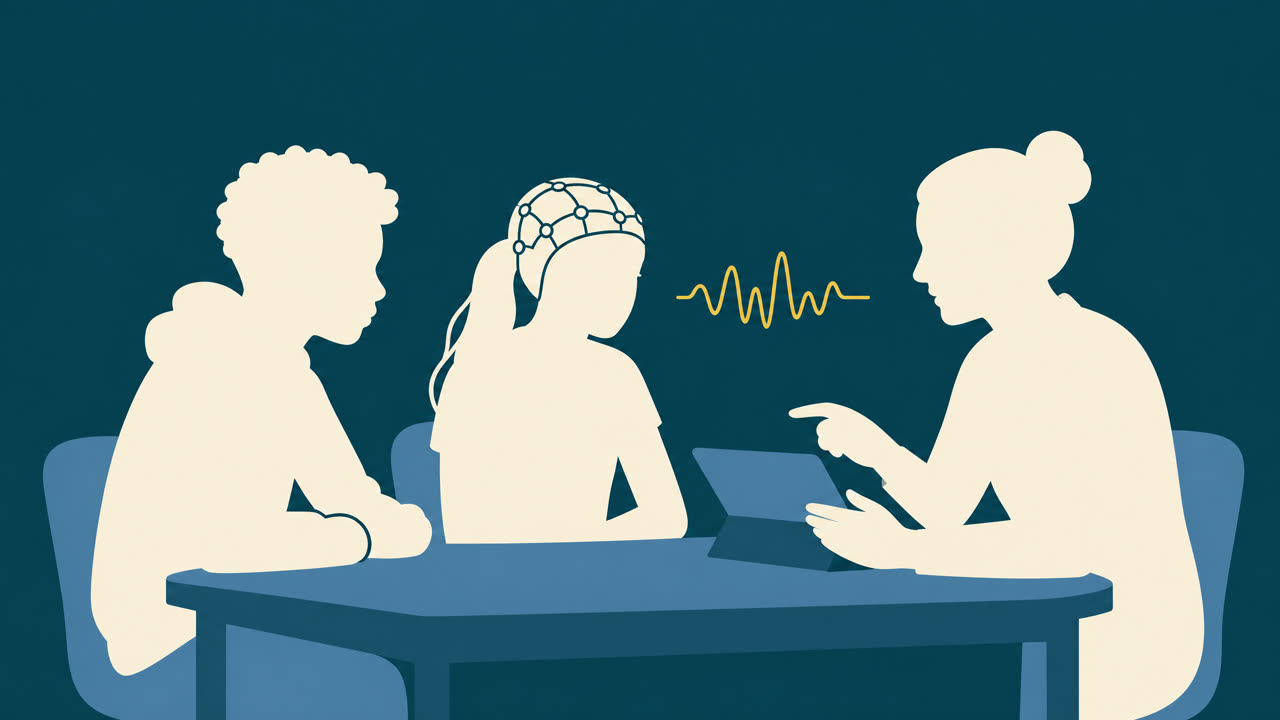
- Learn how the brain works and how scientists study it.
- Watch a live demonstration of EEG.
- Wear a lightweight EEG headset that records the brain’s natural activity, while sitting quietly with their eyes open or closed.
- Do a simple computer task.
- Answer short questionnaires about their background, wellbeing and everyday life, including their phone use: about 10 minutes.
What EEG is
EEG stands for electroencephalography (eh-lek-tro-en-seh-fuh-loh-gra-fee). A lightweight headset with small sensors sits on the scalp and records the brain’s natural electrical activity. Nothing is sent into the brain: EEG only listens.
EEG cannot read thoughts, feelings or personality, and the study does not diagnose anything. It is a research tool, not a medical test, and nobody receives individual results.
Safety and preparing
EEG is safe, painless and non-invasive, and is widely used in research.
Is it safe?
- The headset should feel comfortable. Hair does not need to be cut or shaved.
- Headsets are cleaned and disinfected between sessions.
- In extremely rare cases, an EEG recording may trigger a seizure in someone with epilepsy, so young people with a known history of epilepsy or seizures do not do the EEG recording. They can still join the rest of the workshop. If this applies to your child, please tell the school or email us before the workshop.
- Researchers hold enhanced DBS certificates and follow the school’s safeguarding procedures. At least two are there at all times, and no researcher is ever alone with a young person.
How to prepare
- No special preparation is needed.
- Clean, dry hair, without gel, oil, spray or other hair products, helps the sensors work.
- Long hair can be tied back so the headset sits comfortably.
- Young people who wear religious head coverings can use a private space during the session if they need to.
Screen time and phone habits
Separate from the workshop, and only if you choose: online, on this website, you answer a few questions about your child’s phone habits and can share screenshots of their phone’s screen-time summary. It takes about five minutes.
What the screenshots show
The phone’s Screen Time page (iPhone) or Digital Wellbeing page (Android): which apps were used, and for how long. Not messages, photos, videos, posts or contacts, and not what was watched or searched. Any part of a screenshot can be hidden before it is sent.
Who decides
Under 16: a parent or carer gives permission first, on the form, and says where the screen time can come from. If you can see your child’s screen time on your own phone, with Apple Family Sharing or Google Family Link, you can send it from there. Otherwise your child sends it from their own phone, if they want to: it is their choice too.
16 or over: young people decide for themselves, without a parent.
The parent or carer also answers some short questions about their child’s phone and social media use, whether or not the screen time is shared: about three minutes, and any question can be skipped. On the form, a parent or carer gives their name, their relationship to the young person and their home address and postcode, so that records can be matched correctly; an email address and phone number are optional. What you give is saved from the moment you sign, so it counts even if you can’t finish, and you can finish later with the reference on your thank-you page.
Linking with education and health records
For young people who take part in the workshop, the study links their information with records that already exist about them, to look at longer-term patterns in learning, health and wellbeing.
The records are education records, such as attendance and results, held by the Department for Education, and NHS health records. The linking is done through Connected West Yorkshire, using your child’s Unique Pupil Number, which the school gives us, and only with the approvals in place.
It happens inside a secure research environment: names and other details that identify someone directly are removed before researchers see anything, the analysis stays inside that environment, and only results about groups of people come out. Linking is part of the workshop, so opting out of the workshop also opts your child out of linking.
What happens to your child’s information
It is kept securely by the University of Leeds, labelled with a study code instead of a name, and used only for research, including research using machine learning (computers finding patterns in data).
- What is collected: at the workshop, the EEG recording, the computer task and the questionnaire answers. From the school, your child’s name, date of birth, year group, class and Unique Pupil Number, so that their information can be matched and linked. If you use the online form, the details and answers you give there, and any screenshots.
- How it is labelled: research data carry a study code, never a name. Names, dates of birth, Unique Pupil Numbers, contact details and opt-out records are kept separately, and only the few people who need them can see them.
- Who sees it: only the research team and approved collaborators, through secure systems. Teachers, the school and other pupils never see your child’s answers, recordings or screenshots.
- How long it is kept: up to 10 years after the project ends, as the University’s research data rules require. Identifying information is then securely deleted; fully anonymous data may be kept for future research.
- How results are shared: in scientific journals, at conferences, in reports and in future research, and as general findings for the schools taking part. Results are about groups of young people, never individuals. Fully anonymous EEG recordings, with no names or other identifying details, may be shared with other researchers through research data platforms.
- Never sold: we do not sell data or give it to social media or other commercial companies.
- The law: the University of Leeds is the data controller. It uses the information because research is a task in the public interest (UK GDPR Article 6(1)(e)) and, for sensitive information such as health records and information about wellbeing, because the processing is for research in the public interest (Article 9(2)(j)). The University’s research participant privacy notice explains your rights; ask us if you would like a copy. More on our data and privacy page.
More about the study
Who runs it, who funds it, and how long it lasts.
Your child’s school has agreed to take part for up to three school years, so that we can see how things change as young people grow up. Each year is a fresh choice, and you can opt your child out at any time.
The study is funded by the Huo Family Foundation and led by Professor Faisal Mushtaq at the University of Leeds, working with Born in Bradford and the Centre for Applied Education Research. There is a version of this information for young people.
Changing your mind
You and your child can change your minds at any time, without giving a reason.
- On the day: your child can stop at any time. They just tell a researcher or their teacher.
- Afterwards: email brainpop@leeds.ac.uk, quoting the reference from the online form if you have one. You can withdraw everything, or just the screenshots or your answers.
- How much can be removed: ask within one month of the workshop and we can remove all of your child’s information. After that, information that has been made anonymous, or already used in analyses, may no longer be removable; we remove everything we still can. Opting out after the workshop withdraws your child’s information, including from linking, in the same way.
- None of this affects your child’s education or their relationship with school.
Opting out
If you don’t want your child to take part in the workshop, one email from a parent or carer is all it takes.
How to opt out
A parent or carer emails brainpop@leeds.ac.uk with your child’s full name, their school and their class or year group, and your name. The opt-out page first explains what your child would miss, then writes the email with you. Please email before the workshop. If your email arrives after it, we withdraw your child’s information too, as far as is still possible. Opting out will not affect your child’s education or their relationship with school.
Why the workshop is opt-out
We want the study to include young people from every background. When families have to return a form before their child can take part, young people from busier households, or from families who hear less from school, are often left out, and the findings would not reflect them. So every young person in the classes taking part is invited. The choice still stays with you and your child:
- you can opt your child out before the workshop;
- on the day, your child decides for themselves whether to take part;
- answering our questions and sharing their screen time is a separate choice, made online.
Questions and approval
We are happy to answer any question, before or after the workshop.
Email the MyPhone/MyBrain team at brainpop@leeds.ac.uk; we aim to reply within five working days. You can also contact Kate Hiley at K.E.Hiley@leeds.ac.uk, or the study lead, Professor Faisal Mushtaq, at F.Mushtaq@leeds.ac.uk, both at the School of Psychology, University of Leeds. To opt out, please use the team’s address, brainpop@leeds.ac.uk.
Need this information in another language, in an easier-to-read version or on paper? Contact us and we will send you what works for you. There are also questions and answers.
This study has been approved by the University of Leeds School of Psychology Research Ethics Committee, reference SoPREC 4202, on 11 June 2026. The University’s data protection team signed off its data protection impact assessment in May 2026.
Last updated 7 October 2026.