Thinking abouttaking part?
Secondary schools in Bradford and Leeds can join the study. Here is what it involves, what we ask of a school, and the form to get started.
Information for schools
MyPhone/MyBrain works with schools in Bradford and Leeds. We plan the sessions with you, so they fit your timetable, safeguarding arrangements and communication with families.
Our team brings the equipment and runs the sessions. Before you decide whether to take part, we will explain what is involved and answer your questions.
Why schools take part
Real neuroscience, in your classroom.
Most pupils only meet brain science in a textbook. In a MyPhone/MyBrain workshop they learn how the brain works from working neuroscientists, fit lightweight EEG headsets on each other, watch their own brain’s signals appear live on screen, and use them in real experiments.
It is an opportunity well outside the usual curriculum: hands-on research with real equipment, a real study to be part of, and researchers who can talk about university and science careers. A chance to inspire pupils about science, whatever they go on to do.
What a session looks like →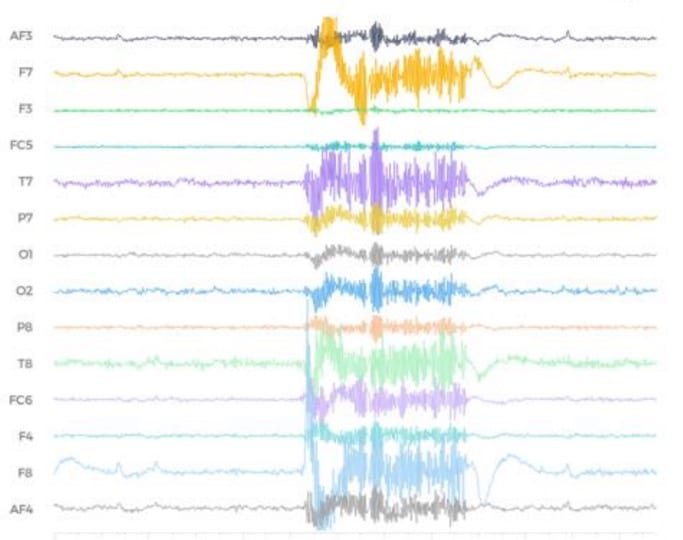
Already tested in schools
- Schools
- 8
- Students
- 1,000+
In pupils’ own words
“An informative workshop, I got to see my own brain signals. I am considering a career in psychology so this tool might be something I use again in the future.”
“I learnt how focusing on tasks change the brain waves - this can be helpful with studying and trying to focus.”
“The EEG session was interesting and fun to do, like how all of the monitors went off when clenching the jaw.”
Learning linked to the curriculum
Designed with teachers from Key Stage 3 to Key Stage 5. Pupils explore brain science, measurement, data and research through hands-on activities that link to science, psychology, computing and PSHE.
Beyond the usual curriculum
Real neuroscience that pupils rarely get to do at school, with researchers who can talk about university, research and science careers.
A study designed for pupils
Young people, parents and teachers have helped shape the project. We have adapted the EEG session for different hair types, religious head coverings and comfort needs.
Useful evidence for the future
Your school helps build better evidence about a topic that matters to young people, families and schools.
MyPhone/MyBrain can help schools evidence three Gatsby Benchmarks:
Linking curriculum learning to careers
Through curriculum-linked science, psychology, computing and data activities.
Encounters with employers and employees
Through meaningful encounters with researchers, research software engineers and data specialists.
Encounters with further and higher education
Through direct engagement with university-led research and higher education pathways.
Schools can record participation within their careers programme using their usual Compass/Compass+ processes.
What happens in a workshop
- Pupils learn how the brain works and how scientists study brain activity.
- A live demonstration of EEG (electroencephalography): the brain's signals appear on screen as it happens.
- Pupils who agree fit lightweight headsets on each other, with our help, and see their own brain's signals.
- A short recording while they sit quietly, then simple computer tasks about attention and self-control.
- Short questionnaires about their background, wellbeing and everyday life, including their phone use, and time to ask the researchers about science and careers.
- Separately, and only if the family opts in online, screenshots of the phone's screen-time page: which apps were used and for how long.
Our team brings all the equipment and staff. Every part is a choice: pupils can say no to any part, or stop at any time. What a session looks like, step by step.
Safeguarding and approvals
- Everyone from our team who works in your school holds an enhanced DBS certificate. We send you the certificates before our first visit.
- At least two researchers are present at all times, including while setting up and packing away. No researcher is ever alone with a pupil.
- We follow your school's child protection, health and safety policies and codes of practice, and ask for copies before we visit.
- The study was approved by the University of Leeds School of Psychology Research Ethics Committee (reference SoPREC 4202) on 11 June 2026. We can send you the approval letter.
Getting ready for a visit
- Before testing begins, we ask staff whether any pupils have disabilities or medical conditions we should know about.
- Pupils with a known history of epilepsy or seizures do not take part in the EEG recording, but can join the rest of the workshop.
- Pupils should come with clean, dry hair, without gel, oil or spray; long hair can be tied back. Hair never needs to be cut or shaved.
- Where needed, the headset can be fitted in a private room, and female researchers are available on request, for comfort or religious reasons.
What your school gets
- A two-hour neuroscience workshop for each group, run by our team with our equipment.
- Links with science, computing and PSHE, and evidence towards Gatsby Benchmarks 4, 5 and 7.
- Group findings for your school's pupils at the end of each school year, never about individual pupils.
- A follow-up session to share what we found with your school community.
Your school’s link for parents
When your visit is agreed, your school gets its own page for parents and carers, at an address such as myphonemybrain.com/your-school. It explains the study and opens the online form with your school already filled in. Share it through your usual channels, such as a letter, email or the school app, rather than public social media.
For example, myphonemybrain.com/dua.
What we ask of a school
- Up to three school years. We visit again each year, and each year your school decides whether to carry on.
- Two-hour workshops for groups of up to 30 pupils, during the school day, from two or more year groups. We can run up to three a day.
- A classroom, and a private room nearby when a pupil needs one.
- A named contact who plans the visits with us, shares our information with families and links with your safeguarding lead.
Join the study with your school
Secondary schools in Bradford and Leeds can join MyPhone/MyBrain. Tell us about your school and we will get in touch to talk it through. Nothing is agreed until you have all the information and want to go ahead.
The form asks you to confirm two of the things on this page: two-hour workshops for groups of up to 30 pupils, and two or more year groups.
What happens next
- Your message comes straight to the research team.
- We reply within five working days to arrange a conversation.
We use these details only to reply to you. Before a school joins, the team provides the full study information, consent materials and data protection information.